volleyball 5-1 rotation pdf
Category : PDF
Volleyball 5-1 Rotation: A Comprehensive Guide
Understanding the 5-1 volleyball rotation is crucial for team success, offering flexibility and consistency in offense and defense. PDF resources detail player positioning
during serve, receive, and base defense, showcasing the 5 hitters and 1 setter setup.
Understanding the 5-1 System
The 5-1 system in volleyball signifies a strategic approach to gameplay, employing five hitters and one dedicated setter. This configuration, often detailed in PDF guides for coaches and players, prioritizes offensive consistency and adaptability. Unlike the 6-2, which utilizes two setters, the 5-1 relies on a single setter to orchestrate the team’s attacks throughout the entire rotation.
PDF resources emphasize that the core of the 5-1 lies in the setter’s ability to consistently deliver accurate sets to the hitters. This system demands a highly skilled setter capable of making quick decisions and adjusting to various offensive plays. The PDF documents also illustrate how the 5-1 allows for a more dynamic offense, as hitters can attack from multiple positions, creating challenges for the opposing team’s defense.
Furthermore, the 5-1 rotation promotes a stronger defensive presence, as the consistent positioning of players allows for better coverage and blocking schemes. Many PDF guides include diagrams illustrating these defensive formations, helping teams visualize and practice their positioning. Ultimately, the 5-1 system, as explained in available PDF materials, is a versatile and effective strategy for teams seeking to maximize their offensive and defensive potential.
The Core Principles of a 5-1 Rotation
The foundational principles of a 5-1 volleyball rotation, often outlined in detailed PDF guides, center around a single setter’s consistent involvement in every rally. This contrasts with systems requiring setter substitutions, ensuring uninterrupted offensive flow. PDF resources highlight the importance of the setter’s court awareness and decision-making skills, as they dictate the tempo and variety of attacks.

A key principle detailed in these PDF documents is the designated hitter roles. Outside hitters typically receive the majority of sets, acting as primary attackers, while the opposite hitter provides offensive balance. The middle blocker’s role, as explained in PDF guides, is crucial for both blocking and quick attacks. Effective communication, visually represented in diagrams within the PDFs, is paramount for seamless transitions and coverage.
Furthermore, the PDFs emphasize the libero’s specialized defensive role, providing consistent back-row coverage. Successful 5-1 implementation, as demonstrated in these resources, relies on players understanding their responsibilities within each rotation and adapting to opponent strategies. Mastering these core principles, as presented in PDF training materials, is essential for maximizing the system’s effectiveness.
Benefits of Utilizing a 5-1 Rotation

PDF guides on the 5-1 volleyball rotation consistently emphasize its advantages in offensive consistency. Having a dedicated setter involved in every play fosters a predictable rhythm, allowing hitters to develop stronger timing and build rapport. These resources detail how this system maximizes offensive options, enabling diverse attack strategies and exploiting opponent weaknesses.
A significant benefit, highlighted in PDF analyses, is improved ball control. The single setter’s consistent presence streamlines the offensive process, reducing errors and increasing the efficiency of attacks. PDF diagrams illustrate how the 5-1 facilitates quicker transitions between offense and defense, minimizing vulnerabilities.
Furthermore, PDF training materials showcase the 5-1’s adaptability. While requiring specialized player skills, the system allows for strategic adjustments based on opponent strengths. The PDFs also point to enhanced team communication as a key benefit, fostering a cohesive unit capable of responding effectively to changing game dynamics. Ultimately, the 5-1, as detailed in these resources, provides a framework for sustained offensive pressure and defensive stability.

Player Positions in a 5-1 System
PDF guides detail key roles: setter, outside hitters, middle blocker, opposite hitter, and libero. Understanding each position’s responsibilities is vital for a successful 5-1 volleyball rotation.
The Setter (S) Role and Responsibilities
Within the 5-1 volleyball rotation, the setter (S) is the team’s orchestrator, responsible for delivering accurate and strategic sets to hitters. PDF resources emphasize the setter’s critical decision-making skills, needing to quickly assess the block and hitter matchups. They dictate the tempo of the offense, choosing when to set quick, medium, or high balls.
The setter’s responsibilities extend beyond just setting; they must also be a consistent server, a reliable defender, and a smart blocker when not setting. PDF diagrams illustrate the setter’s movement patterns, showing how they transition from setting to covering their hitter’s block. A strong setter anticipates the play, communicates effectively with teammates, and maintains composure under pressure. They are often the team’s primary ball handler, requiring exceptional technique and control. Mastering these skills, as detailed in volleyball rotation PDF guides, is paramount for offensive success.
Furthermore, the setter needs to be a leader on the court, providing guidance and encouragement to their teammates. Their ability to read the game and make quick adjustments is crucial for maximizing the team’s offensive potential.
Outside Hitters (OH) – Primary Attackers
Outside Hitters (OH) are the primary offensive weapons in a 5-1 volleyball rotation, receiving the majority of sets from the setter. PDF guides highlight their responsibility for terminating plays with powerful attacks, often facing the opposing team’s best blockers. They must possess a diverse hitting arsenal, including line shots, angle shots, and roll shots, adapting to the block presented.
Beyond attacking, OHs are crucial in serve receive, consistently passing the first contact to initiate the offense. PDF diagrams demonstrate their positioning in various serve receive formations, emphasizing the importance of accurate passing. They also contribute significantly to blocking, defending against the opponent’s outside hitter. A successful OH is a well-rounded player, excelling in both offensive and defensive skills.
Volleyball rotation PDF resources detail the OH’s movement patterns, showing how they transition from back-row attacks to front-row blocking. They require exceptional athleticism, jumping ability, and court awareness. Consistent performance from the OHs is vital for a team’s overall success.
Middle Blocker (MB) – Defensive and Offensive Presence
Middle Blockers (MB) are the first line of defense at the net in a 5-1 volleyball rotation, responsible for shutting down the opponent’s attacks. PDF resources emphasize their crucial role in reading the opposing setter and anticipating the hitter’s approach. Effective blocking requires quick reflexes, precise timing, and strong jumping ability, forming a formidable wall against opposing attacks.
Offensively, MBs contribute with quick attacks, often utilizing short sets near the setter. PDF diagrams illustrate their movement patterns for quick hits and slides, demanding agility and coordination. While not receiving the majority of sets, their attacks keep the defense honest and create opportunities for the outside hitters. They must be efficient and decisive with their limited offensive opportunities;
Volleyball rotation PDF guides detail the MB’s lateral movement along the net, covering multiple hitting lanes. They are vital in transitioning quickly from blocking to offense, requiring excellent conditioning and court awareness. A strong MB significantly impacts a team’s defensive and offensive capabilities.
Opposite Hitter (OP) – Versatile Attacker
The Opposite Hitter (OP) in a 5-1 volleyball rotation serves as a crucial secondary attacker and a key defensive player. PDF guides highlight their versatility, often being the primary option when the setter is blocked or out of position; They must be proficient in hitting from various locations and set types, including high balls and back-row attacks.

Defensively, the OP often lines up against the opponent’s outside hitter, requiring strong blocking skills and the ability to read the hitter’s tendencies. PDF diagrams illustrate their blocking assignments and defensive responsibilities, emphasizing the need for quick lateral movement and solid footwork. They provide essential back-row defense, covering tips and rolls.
Volleyball rotation PDF resources demonstrate the OP’s role in stabilizing the team’s offense, offering a reliable option when the primary hitters are contained. They need a high volleyball IQ and the ability to adapt to different game situations, making them a valuable asset to any team.
Libero (L) – Defensive Specialist
The Libero (L) in a 5-1 volleyball rotation is a dedicated defensive specialist, crucial for ball control and extending rallies. PDF guides emphasize their unique rules – restricted attacking and blocking – focusing instead on exceptional digging, passing, and court coverage. They wear a contrasting jersey color for easy identification by referees.
PDF diagrams illustrate the Libero’s seamless substitution pattern, replacing a back-row player without counting as a regular substitution. This allows for consistent defensive stability. They are masters of reading the opponent’s attack, anticipating tips and rolls, and delivering accurate passes to the setter. Their quick reflexes and agility are paramount.
Volleyball rotation PDF resources detail the Libero’s role in serve receive, often taking the most difficult serves. They are vital in transitioning the ball efficiently, enabling the team’s offensive plays. A skilled Libero significantly elevates a team’s defensive capabilities and overall performance.
5-1 Rotation Diagrams and Visualizations
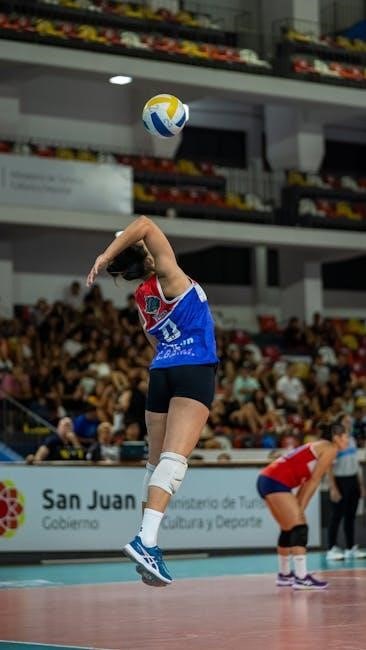
PDF resources provide essential 5-1 volleyball rotation diagrams, illustrating player positioning during serve, receive, and defense. Visualizations clarify movements and responsibilities for each rotation.
Rotation Diagram: Positions 1-6
Visualizing the 5-1 rotation through a diagram detailing positions 1-6 is fundamental to understanding player movement and responsibilities. PDF guides commonly illustrate this, showing the initial setup with the setter in position 2. As the team rotates clockwise, each player transitions through all six positions.
Position 1 typically houses a front-row hitter, while position 6 is occupied by the serving player. The setter strategically moves to position 2 to initiate the offense, then rotates through back-row defensive roles. Diagrams highlight the flow, demonstrating how hitters cycle through front and back row, adapting to both offensive and defensive demands.
Understanding these positional shifts is crucial for effective serve receive and defensive coverage. PDF resources often label positions with player roles (S for setter, OH for outside hitter, MB for middle blocker, OP for opposite hitter, and L for libero), providing a clear visual representation of the 5-1 system’s dynamic nature. Mastering this rotation requires consistent practice and a thorough grasp of each position’s duties.
Serve Receive Formations in 5-1
Effective serve receive is paramount in a 5-1 system, and PDF guides often detail common formations. Typically, a “W” or diamond shape is employed, with the libero positioned centrally to cover deep shots. Three receivers spread across the front row establish lanes, ensuring comprehensive coverage of the opposing team’s serve.
The setter, usually starting in position 2, plays a crucial role in directing the receive and transitioning to set. PDF resources illustrate how hitters adjust their positioning based on the serve’s trajectory, prioritizing ball control and accurate passing to the setter. Communication is key; players call out the serve and their intended coverage area.
Variations exist depending on the opponent’s serving tendencies. Some teams utilize an inverted “W” or a more aggressive, spread-out formation. PDF documents emphasize adaptability, highlighting the importance of players understanding their responsibilities within different receive patterns. Successful serve receive sets the stage for a potent offensive attack, maximizing the 5-1’s potential.
Defensive Coverage in a 5-1 System
Robust defensive coverage is a hallmark of a well-executed 5-1 rotation, and PDF guides illustrate effective strategies. The libero, a defensive specialist, anchors the back row, responsible for covering tips and deep attacks. Middle blockers prioritize blocking and then transition to cover cut shots and quick attacks along the net.
Outside hitters defend their respective zones, focusing on line shots and angle attacks. The opposite hitter provides support on the right side, covering both blocking and defensive responsibilities. PDF resources emphasize the importance of reading the opposing hitter and anticipating their attack.
Rotation awareness is critical; players must seamlessly transition to their defensive positions as the rotation unfolds. PDF diagrams showcase how players adjust their coverage based on the opposing team’s offensive patterns. Effective communication – calling out hitters and anticipating attacks – is vital for a cohesive defensive unit. A strong defense complements the 5-1’s offensive power, creating a balanced and formidable team.
Implementing the 5-1 Rotation
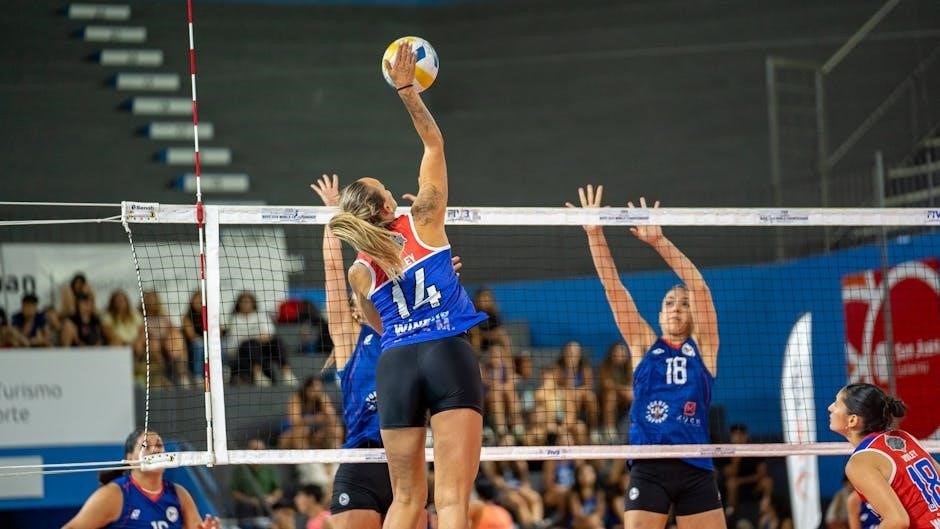
Transitioning to a 5-1 requires focused drills, detailed in PDF guides, to master movements and adapt to opponent strengths. Consistent practice builds
rotational fluency and strategic adjustments.
Transitioning from Other Rotations to 5-1
Shifting to a 5-1 rotation from systems like the 6-2 demands a deliberate approach, focusing on player adaptation and skill refinement. PDF resources often highlight the importance of simplifying initial drills, emphasizing the single setter’s role and the increased hitting responsibilities for the remaining players.
Previously, in a 6-2, hitters might have occasionally set; now, that responsibility is solely with the designated setter. This requires hitters to fully commit to offensive execution and consistent positioning. Defensive adjustments are also key, as the 5-1 often necessitates more specialized roles and quicker rotations.
PDF guides frequently recommend breaking down the rotation into segments – serve receive, defense, and offense – practicing each independently before integrating them. Coaches should prioritize clear communication and repetition, ensuring players understand their new assignments and responsibilities within the 5-1 framework. Patience is vital, as mastering this rotation takes time and dedicated effort.
Drills for Mastering 5-1 Rotation Movements
Effective 5-1 rotation mastery relies on targeted drills, as detailed in many PDF coaching resources. Begin with “Rotation Recognition” drills, where players call out their position after each shift, reinforcing spatial awareness. “Serve Receive Flow” drills simulate game-like scenarios, emphasizing quick transitions and accurate passing to the setter.
“Defensive Shuffling” drills focus on lateral movement and coverage responsibilities, crucial for a solid back row defense. PDF guides often include “Setter Footwork” drills, honing the setter’s ability to quickly access hitters from various positions. Integrate “Offensive Transition” drills, where players practice moving from defense to offense seamlessly.

Progress to more complex drills combining all aspects of the rotation. Coaches should emphasize repetition and provide constructive feedback. PDF materials suggest incorporating game-like pressure by adding scoring or time constraints. Consistent practice of these drills builds muscle memory and enhances team coordination, leading to a smoother, more efficient 5-1 system.
Adjusting the 5-1 Based on Opponent Strengths
Strategic adaptation is key to maximizing the 5-1 rotation’s effectiveness, as highlighted in numerous PDF coaching manuals. If facing a strong outside hitter, shift blocking focus and potentially double-team, adjusting defensive coverage accordingly. Against a dominant middle blocker, utilize tempo variations and off-speed sets to disrupt their timing.
PDF resources emphasize scouting reports to identify opponent tendencies. If they consistently target the right side, reinforce that defensive area and consider adjusting your own offensive distribution. When encountering a weak passer, exploit this by strategically placing serves to disrupt their serve receive formation.
Furthermore, modify offensive schemes based on the opponent’s blocking scheme. Utilize roll shots or quick sets to exploit gaps. PDF guides suggest pre-scouting analysis to prepare tailored adjustments. Remember, a rigid 5-1 system is less effective than a flexible one, capable of responding to the opponent’s strengths and weaknesses.

Advanced 5-1 Concepts
PDF guides detail advanced 5-1 strategies, including tempo setting, reading the block, and refined communication. Mastering these nuances elevates offensive variation and defensive adaptability.
Tempo Setting and Offensive Variations
Tempo setting within a 5-1 system, as often illustrated in volleyball rotation PDF guides, is about more than just getting the ball to the hitters. It’s about controlling the speed and timing of the set to disrupt the opposing block and create optimal hitting opportunities. A quicker tempo set demands faster reactions from the blockers, potentially opening up more lanes for attackers.
PDF resources emphasize variations like back-set, high-ball, and one-on-one sets, each designed to exploit specific defensive weaknesses. The setter must read the block effectively, anticipating where the defenders will commit and adjusting the set accordingly. A well-executed back-set can catch the block moving the wrong way, while a high-ball set allows the hitter to take more time to assess the situation and choose their shot.
Furthermore, PDF diagrams often showcase how different offensive schemes – such as slide attacks from the middle blocker or quick sets to the outside hitter – can be integrated into the 5-1 rotation. Successful implementation requires precise timing, strong communication between the setter and hitters, and a deep understanding of each player’s strengths and weaknesses. The goal is to keep the opposing defense guessing and prevent them from establishing a solid blocking presence.
Reading the Block and Adjusting Attacks
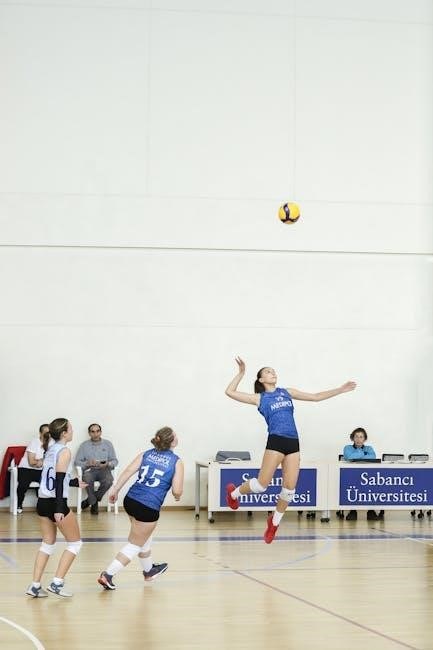
Reading the opposing team’s block is paramount in a 5-1 volleyball rotation, and detailed PDF guides often dedicate sections to this skill. Attackers must quickly assess the block’s formation – identifying seams, recognizing tendencies, and anticipating movements – before making their hitting decision. A solid block read allows hitters to target open areas or exploit weaknesses in the defensive coverage.
PDF resources illustrate how hitters can adjust their attacks based on the block’s positioning. This includes altering the angle of their approach, changing the height of their jump, or opting for different shot selections like roll shots, cut shots, or tips. If the block is closing hard on the outside hitter, for example, a well-timed roll shot can catch the defense off guard.
Effective communication between the setter and hitter is crucial for successful block reads and attack adjustments. The setter can provide valuable insights based on their vantage point, while the hitter can relay information about the block’s movement; Mastering this skill requires practice, observation, and a deep understanding of the opposing team’s blocking schemes, as often detailed in comprehensive volleyball rotation PDFs.
Communication Strategies within the 5-1 Rotation
Effective communication is the cornerstone of a successful 5-1 volleyball rotation, and many PDF guides emphasize its importance. Clear, concise calls between players are vital for seamless transitions, coordinated attacks, and solid defensive coverage. The setter must communicate their setting intentions, while hitters relay their preferred hitting options and read on the block.
PDF resources often highlight specific communication protocols, such as using designated terms for different shots (e.g., “line,” “angle,” “tip”) and employing hand signals for quick adjustments. Defensive communication is equally crucial, with players calling out assignments, identifying potential threats, and coordinating blocking schemes. Consistent terminology ensures everyone understands their roles and responsibilities.
Beyond verbal cues, non-verbal communication – eye contact, body language, and pre-set signals – plays a significant role. A strong team culture fosters open communication, encouraging players to provide feedback and support each other. Mastering these communication strategies, as detailed in volleyball rotation PDFs, elevates team cohesion and maximizes performance on the court.